Contact us
|
Whatsapp
Whatsapp:+86 13889850231
Whatsapp:+86 13889850231

Polyester fiber (PET fiber) is a synthetic fiber produced by melt-spinning polyethylene terephthalate (PET). The fiber features high strength, high modulus, good heat resistance, acid and alkali resistance, UV resistance, and wear resistance. PET fiber has a melting point above 200°C and can be used long-term at temperatures up to 150°C, with good dimensional stability.
Polyester fiber has two primary application forms in the construction field: one is direct incorporation into cement-based materials in fiber form to improve crack resistance, toughness, and durability of concrete and mortar; the other is processing into nonwoven fabrics through spunbond or needle-punching processes for use as waterproofing membrane carriers, geotextiles, filtration materials, and other engineering applications. Based on these characteristics, polyester fiber plays multiple roles in modern construction engineering.
Control of Early-Age Plastic Cracking
During the early hardening stage of concrete and mortar, evaporation of water and plastic shrinkage can lead to early-age plastic cracking. These micro-cracks not only affect the surface quality of the structure but also serve as pathways for moisture and harmful substances to penetrate, compromising structural durability. The incorporation of polyester fiber into cement-based materials can effectively control the formation and propagation of early-age cracks.
The mechanism by which polyester fiber inhibits crack propagation in concrete involves the large number of uniformly distributed fibers bearing a portion of the shrinkage stress and reducing stress concentration at crack tips, thereby delaying or preventing crack propagation. The addition of polyester fiber to concrete can significantly suppress crack propagation and improve tensile strength and toughness.
Alkali Resistance and Durability
Polyester fiber exhibits a certain degree of alkali resistance in the alkaline environment of cement-based materials, making it suitable for use in concrete. This characteristic enables the fiber to maintain stable performance over the long term in cement-based materials without rapid degradation due to alkali corrosion. Compared with other synthetic fibers, polyester fiber offers advantages such as resistance to insects, wear resistance, and UV resistance, outperforming polypropylene nonwoven fabrics in these aspects.
Fiber Reinforcement Effect
When PET fiber is used to reinforce mortar and concrete, it improves the mechanical strength of the cement-based mixture. PET resin has higher tensile strength than concrete, and the combination of the two materials achieves higher overall tensile strength, thereby enhancing flexural strength and reducing cracking. With appropriate fiber dimensions, improvements in ductility and toughness of cement-based mixtures can be achieved. At suitable dosage levels, polyester fiber enhances crack resistance while maintaining the required concrete strength grade.
Waterproofing Membrane Carriers
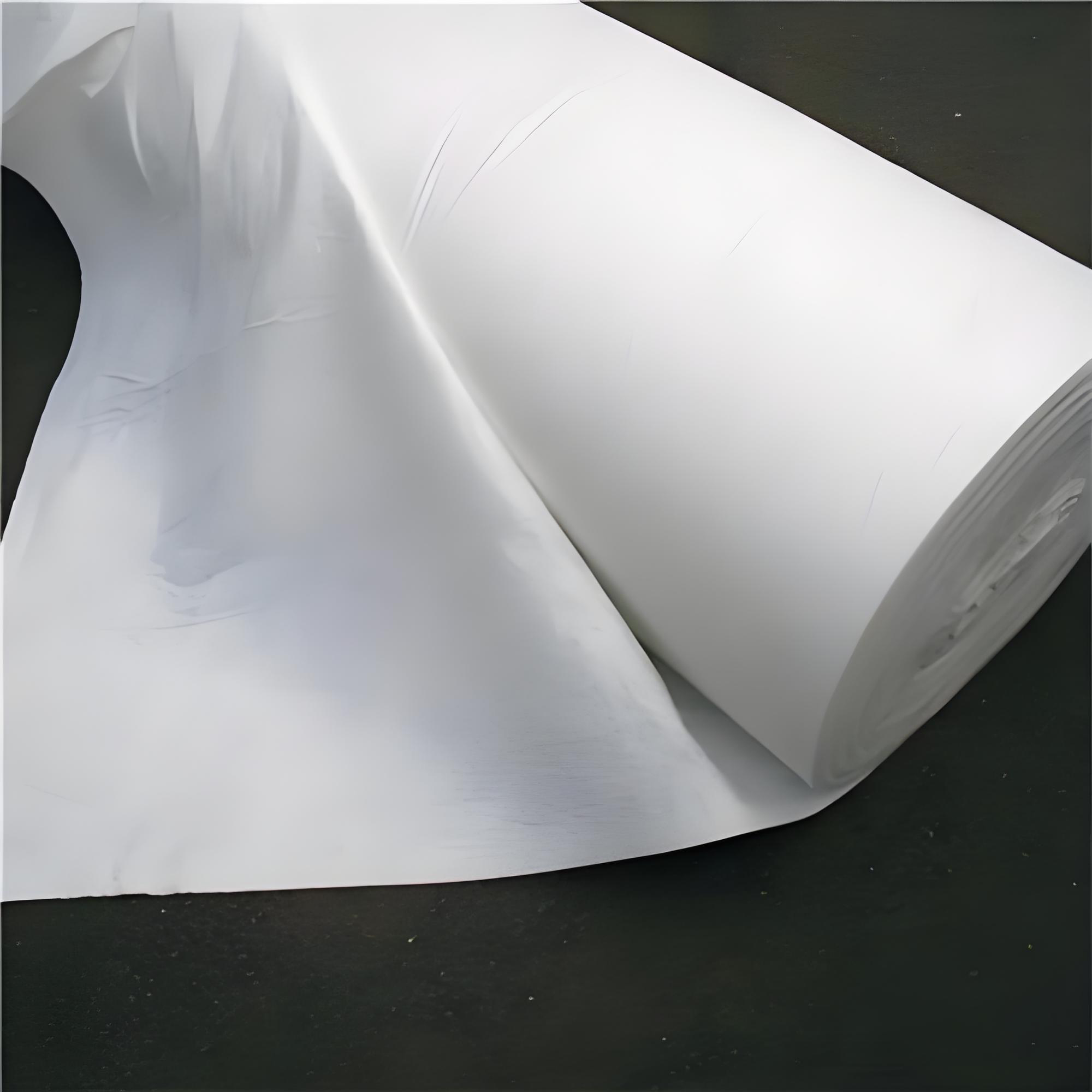
Polyester fiber is the primary raw material for producing PET spunbond nonwoven fabrics. Produced through the spunbond process, this material offers high strength, high temperature resistance, aging resistance, UV resistance, high elongation, good breathability, corrosion resistance, and sound insulation properties. In building waterproofing, PET spunbond nonwoven fabric is widely used as a carrier material for modified bitumen waterproofing membranes.
Geotextile Materials
PET spunbond nonwoven fabrics have broad applications in geotechnical engineering, including soil stabilization, drainage systems, erosion control, and road construction. Compared with polypropylene nonwoven fabrics, PET nonwoven fabrics are non-absorbent, insoluble in water, and highly breathable. With the expansion of infrastructure construction in water conservancy, transportation, and other sectors, demand for geotextiles has grown significantly, and applications of PET spunbond fabrics in engineering protection and environmental remediation continue to expand.
Other Application Areas
Polyester fiber nonwoven fabrics are also widely used in agricultural protection (harvest covers, plant protection mats), industrial filtration, automotive interiors, household products (vacuum cleaner bags, fabric softener packaging), and decorative substrates (wall coverings, flooring backings).
Selection by Application
The selection of polyester fiber products should be determined based on the specific application scenario. For crack resistance and reinforcement in concrete and mortar, surface-treated chopped fibers should be selected to ensure uniform dispersion in the cementitious matrix. For waterproofing membrane carriers, PET spunbond nonwoven fabrics with a basis weight typically ranging from 25 to 260 g/m² should be selected. For geotextiles, needle-punched or spunbond products should be chosen according to project requirements.
Dosage and Construction Control
When used in cement-based materials, the dosage of polyester fiber should be determined based on the specific mix design and performance requirements. Small-batch trials are recommended to verify dispersion uniformity and crack resistance performance before proceeding with full-scale use. Excessive fiber content may affect the workability of the mixture, so the optimal dosage should be determined while ensuring satisfactory construction performance.
Storage and Transportation
Polyester fiber products should be stored in a cool, dry place, protected from prolonged exposure to sunlight and rain. Standard packaging is generally woven bags or cartons, supporting small-batch sample trials and full truckload shipments, with flexible arrangements available according to user requirements.
Consultation Hotline:
+86 13889850231
Email:sales01@xzhch.com
Address:No.33, Nan'er Road, Heping District, Shenyang, Liaoning Province
Copyright © 2002-2025 非商用版本 Registration:Liaoning ICP record