Contact us
|
Whatsapp
Whatsapp:+86 13889850231
Whatsapp:+86 13889850231

Polyester fiber, also known as PET fiber, is a synthetic fiber made from polyethylene terephthalate. As a concrete reinforcement material, polyester fiber plays an important role in construction engineering, particularly demonstrating unique application value in controlling plastic shrinkage cracking and improving component durability.
Compared with traditional steel mesh, polyester fiber is uniformly dispersed throughout concrete in a three-dimensional distribution, improving concrete performance at the microscopic level. This article focuses on the main application areas of polyester fiber and its functional characteristics.
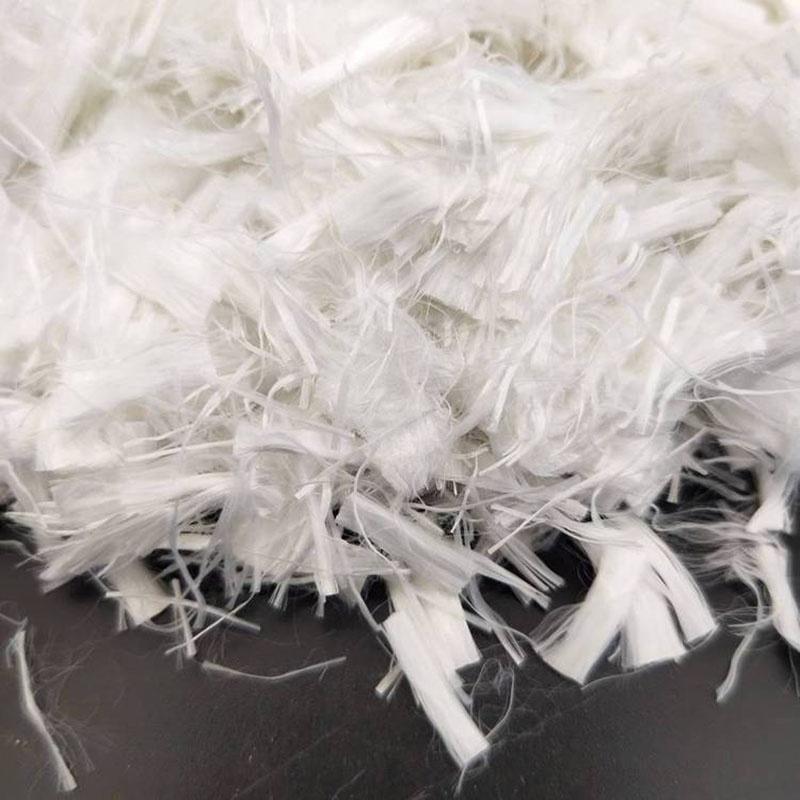
Polyester fiber is a short-cut fiber produced through processes such as melt spinning and cutting using polyethylene terephthalate as raw material. It appears as white or off-white filamentous material with the following basic characteristics:
Physical form: Short-cut fiber typically 3mm-19mm in length, with different specifications available based on application requirements
Density: Approximately 1.36-1.38 g/cm³, similar to concrete density, facilitating easy dispersion
Tensile strength: High tensile strength capable of withstanding certain tensile stresses
Elastic modulus: Moderate elastic modulus, providing good deformation compatibility with the concrete matrix
Chemical stability: Acid and alkali resistant, remaining stable in the alkaline environment of concrete
Dispersion: Surface-treated for uniform dispersion during concrete mixing
The primary application of polyester fiber in concrete is plastic shrinkage crack control.
During the early stages after concrete placement, rapid surface moisture evaporation can easily lead to plastic shrinkage cracking. Polyester fiber uniformly dispersed in concrete forms a three-dimensional network structure, providing the following benefits:
Reduced crack formation:
Uniform fiber distribution effectively bears tensile stresses generated during early shrinkage
Prevents the propagation and connection of micro-cracks
Significantly reduces the number and width of plastic shrinkage cracks
Improved crack resistance:
Increases concrete toughness, improving brittleness
Enhances concrete's ability to resist deformation
Application scenarios:
Large-area floors, pavements, parking lots
Thin-walled structures, precast components
Concrete construction in high-temperature, dry environments
Polyester fiber significantly improves concrete's impact resistance and toughness.
When concrete is subjected to impact loads, the fibers act as a "bridging" mechanism, preventing rapid crack development and absorbing impact energy, thereby enhancing concrete's impact resistance.
Application effects:
Improves concrete toughness, reducing brittle failure
Enhances concrete's ability to resist dynamic loads
Reduces fragmentation under impact
Application scenarios:
Industrial floors, warehouse floors
Airport runways, aprons
Road and bridge wearing surfaces
By controlling cracks and improving internal structure, polyester fiber helps enhance concrete durability.
Mechanism of action:
Reduces the number and width of cracks, limiting pathways for harmful substance ingress
Improves concrete impermeability
Enhances freeze-thaw resistance
Application scenarios:
Hydraulic concrete, water tanks, wastewater treatment facilities
Marine engineering, bridge structures
Various concrete projects with durability requirements
In tunnel and slope support applications, polyester fiber can be used as a reinforcement material for shotcrete.
Application advantages:
Substitutes for some steel mesh, simplifying construction processes
Improves bond strength and crack resistance of shotcrete
Reduces rebound loss, improving material utilization
Application scenarios:
Tunnel linings, mine support
Slope protection, excavation support
Hydraulic tunnel support
In precast component production, polyester fiber helps improve component quality and reduce breakage rates.
Application effects:
Reduces handling and transportation damage to components
Improves edge crack resistance of components
Enhances surface quality of components
Application scenarios:
Precast concrete wall panels, floor slabs
Precast utility tunnels, manholes
Municipal precast components
Polyester fiber dosage in concrete typically ranges from 0.6 kg/m³ to 1.8 kg/m³, with specific dosage determined by project requirements and concrete performance targets:
General crack control requirements: 0.6-0.9 kg/m³
Higher crack control requirements: 0.9-1.2 kg/m³
High crack control or impact resistance requirements: 1.2-1.8 kg/m³
The dosage ranges above are for reference only. Actual dosage should be determined through experimental testing.
Polyester fiber can be used in a manner similar to ordinary concrete, requiring only uniform dispersion during mixing:
Dry mix method: Add fiber uniformly after aggregate addition, dry mix for 30-60 seconds, then add water and admixtures to continue mixing
Wet mix method: Add together with water and admixtures
Extending mixing time by 30-60 seconds is recommended to ensure thorough fiber dispersion.
Fiber should be uniformly dispersed without clumping
Concrete slump may be slightly reduced; this can be compensated by adjusting admixture dosage
No adverse effects on concrete pumpability
Polyester fiber, as a professional concrete reinforcement material, offers application value in controlling plastic shrinkage cracking, improving impact resistance, and enhancing durability. Its ease of application, manageable cost, and stable performance make it an effective choice for industrial floors, roads and bridges, precast components, shotcrete, and other engineering applications.
Understanding the performance characteristics and application methods of polyester fiber helps engineering professionals select and utilize this reinforcement material appropriately to achieve improvements in concrete quality and service life.
Consultation Hotline:
+86 13889850231
Email:sales01@xzhch.com
Address:No.33, Nan'er Road, Heping District, Shenyang, Liaoning Province
Copyright © 2002-2025 非商用版本 Registration:Liaoning ICP record